
Neopentyl glycol (NPG) is a unique chemical compound with the formula C₅H₁₂O₂, playing a crucial role in numerous industrial sectors. Its distinctive structure provides excellent thermal stability, resistance to hydrolysis, and high durability, making it indispensable in the production of polyester resins, coatings, paints, and plastics. We have developed a proprietary technology for producing neopentyl glycol, described in patent PL241915B1, which sets new standards for efficiency and quality in this field.
How Does Our Technology Work?
Our method is based on a modern, continuous production process that combines two key stages:
-
Aldol Condensation: In this stage, isobutyraldehyde reacts with formaldehyde in the presence of a specially selected catalyst, leading to the formation of hydroxypivaldehyde (HPA). This process has been optimized for high efficiency and minimal by-product generation.
-
Hydrogenation: In the next step, HPA undergoes hydrogenation in the presence of a catalyst to produce high-purity neopentyl glycol. The reaction is carried out under controlled conditions in a cascade of reactors, ensuring process stability and exceptional quality of the final product.
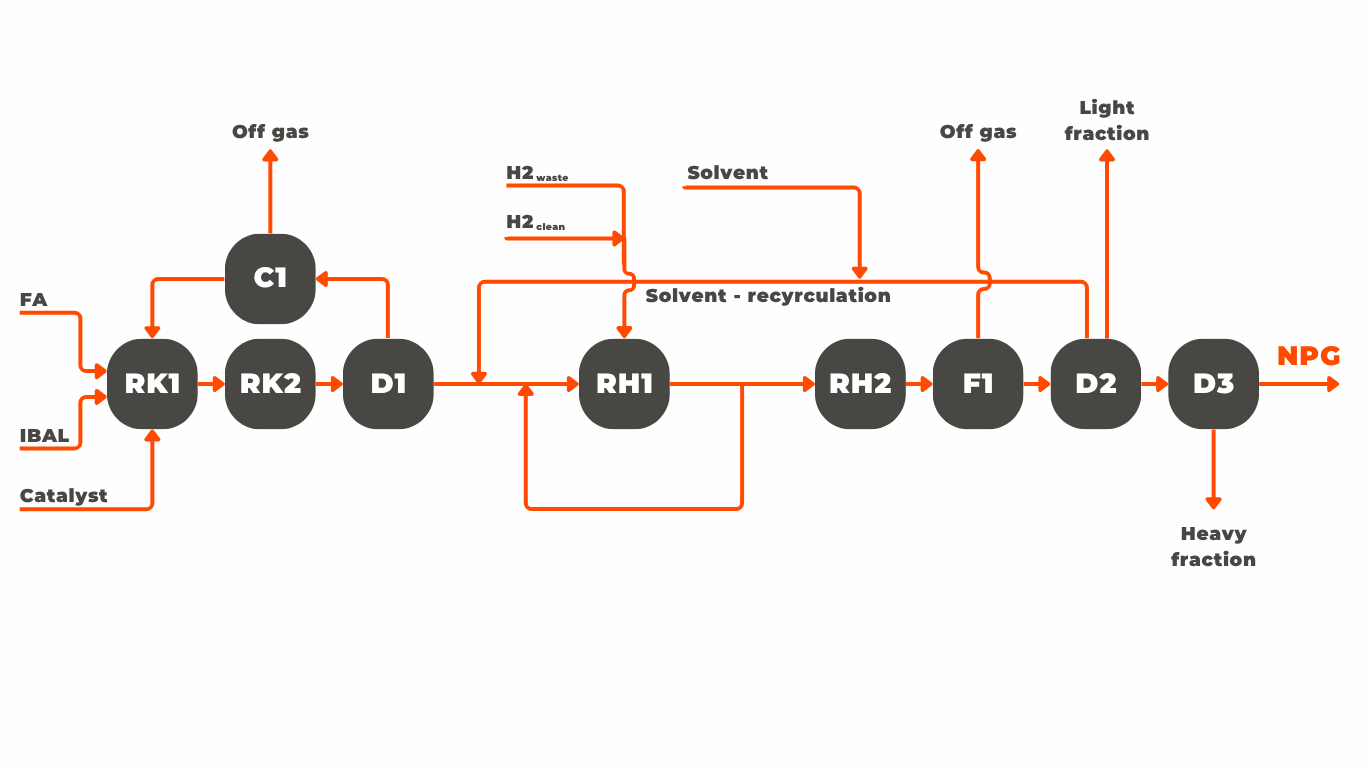
The production of neopentyl glycol (NPG) is carried out in two main stages: aldol condensation and hydrogenation of hydroxypivaldehyde (HPA). The raw materials, isobutyraldehyde (IBAL) and formalin (FA), are introduced into the first reactor, RK1. In this reactor, aldol condensation occurs in the presence of a tertiary amine catalyst, resulting in the formation of hydroxypivaldehyde. The reaction mixture is then transferred to a second reactor, RK2, where the process continues at a higher temperature, improving the conversion of raw materials and process efficiency.
After the condensation stage, the product from RK2 is directed to distillation column D1, where volatile components such as isobutyraldehyde, formalin, and methanol are separated. These recovered components are recycled back to RK1 through cooling unit C1, ensuring efficient resource utilization. The aqueous solution of hydroxypivaldehyde, the main product of condensation, is then prepared for hydrogenation.
Hydroxypivaldehyde enters the first flow reactor, RH1, where it undergoes partial hydrogenation in the presence of a solid catalyst. The reaction mixture then moves to the second reactor, RH2, where the hydrogenation process is completed. RH2 removes remaining heavy by-products and finalizes the conversion of HPA to NPG. The combination of the two hydrogenation reactors, using different catalysts and precisely controlled process parameters, ensures the production of high-purity NPG.
The product from RH2 is sent to the flash tank F1 and then to distillation columns D2 and D3. In D2, light impurities are removed, while in D3, heavy residues are eliminated. The final high-purity neopentyl glycol is collected as the distillate and can be directed for further processing or packaging.
Why Is This Technology Unique?
Our innovative production method offers several advantages that distinguish it from traditional approaches:
- High product purity: The developed technology enables the production of neopentyl glycol with exceptional purity, essential for applications requiring top-quality raw materials.
- Production efficiency: The continuous process and use of advanced catalysts result in increased efficiency, reduced costs, and shorter production times.
- Eco-friendliness and sustainability: Process optimization reduces energy consumption and waste generation, making our technology more environmentally friendly.
Applications of Neopentyl Glycol
NPG finds wide application across various industries, including:
- Chemical industry: Used in the production of polyester resins that provide durability and corrosion resistance.
- Paints and coatings: Its weather-resistant properties make it ideal for protective coatings.
- Plastics: Enhances mechanical strength and thermal stability of materials.